

Brand new plans for a £15billion Severn Barrage that would protect the Burnham-On-Sea area from flooding in the Bristol Channel are unveiled today, Wednesday (July 16th).
Speaking for the first about the project, engineer Rupert Armstrong Evans told Burnham-On-Sea.com about his plans for a 15-mile barrage that will run from Minehead to Aberthaw in Wales.
The ‘Tidal Reef Project’ is radically different to previous schemes planned for Brean Down to Lavernock Point, which critics say would leave Burnham, Brean and Berrow exposed to tidal erosion and potential flooding.
Mr Armstrong Evans’ involvement in tidal and wave power goes back 30 years, having developed sea water powered turbines for oil companies.
He told Burnham-On-Sea.com: “What I am proposing is a radically different concept for tidal power generation that is driven by the need to address environmental issues before than after the engineering has been designed.”
 “I am suggesting a consensus of environmental imperatives are used to define the requirements, in much the same way as the North Sea defined the requirements for building oil platforms, and not the other way round.”
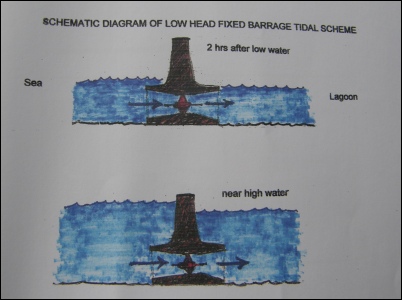
“Our proposal is for a barrage ‘system’ and not one particular turbine design or layout. An outer barrage location from Minehead to Aberthaw and bi-directional generation is favoured.”
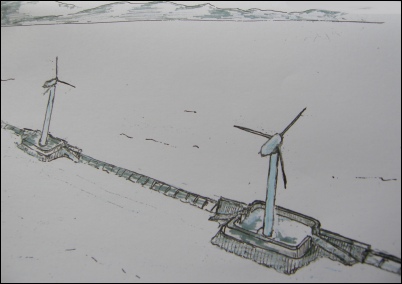
His proposal is for a wall of up to 1,000 water turbines to be built across the 15-mile stretch of estuary, each producing 4 mega watts of electricity. There is a possibility that wind turbines could also be built on top, as pictured at the top of this page.
“The project would comprise of 20km of turbine caissons located over a seabed causeway of pre-cast concerete foundation units, which in turn would be anchored with piles and armour stone. Over 1,000 turbines of 10 metres diameter would produce 500 mega watts for about twice the generation period of the proposed Lavernock Point-Brean Down barrage. The annual generation could therefore be in the order of 20 TWh.”
 The scheme would have an estimated cost of £15 billion and take around six years to build, he added. “I would expect stretches of the barrage to be leased to private power companies to minimise the overall start-up costs.”
“The Burnham-On-Sea area would be far better protected under this scheme not just because it will be behind the barrage, but also because in the event of a storm surge we would control the opening of the barrage to regulate the maximum upstream water levels while land drainage outfalls at a number of loatons compromised by the Lavernock Point-Brean Down barrage ‘holding’ the high water for several hours would be unaffected.”
He went on to claim that the ‘Tidal Reef Project’ would also produce more power than the Lavernock Point-Brean Down barrage.
“According to a 2007 study by Black and Veatch, a barrage west of Minehead would produce 50% more electricity due to the longer power generation period in between tides.”
“There is as much energy lower down the estuary where the height of the tide is lower, it is simply more difficult to capture this energy because the volume of water that has to be passed through the turbines is much greater because of the lower differential head. More turbines are required, but they are simpler in construction and each one is around 5 mega watts. With the ‘reef system’, the generating period is more than doubled and because the basin size is also larger, the available energy is also increased.”
The scheme is due to be discussed in further detail at an environmental conference later in the month.