
Environmental campaigners stepped up their calls for the proposed Severn Barrage to be built at Minehead, instead of Brean Down, during a special debate held in Burnham-On-Sea on Thursday evening (January 17th).
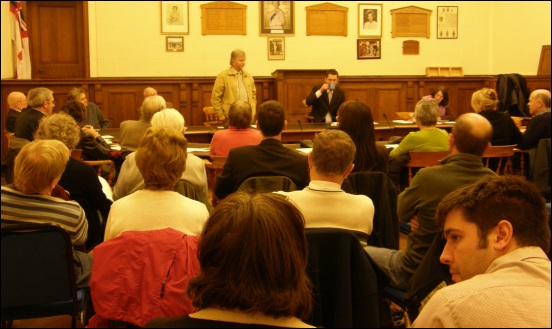
Residents filled the town council’s chambers to hear Gareth Woodham, the man behind ambitious plans to build a barrage and Severn Lake by the year 2020, go head-to-head with Patrick Stokes, Chairman of The Burnham And Somerset Levels Sea Flood Study Group.
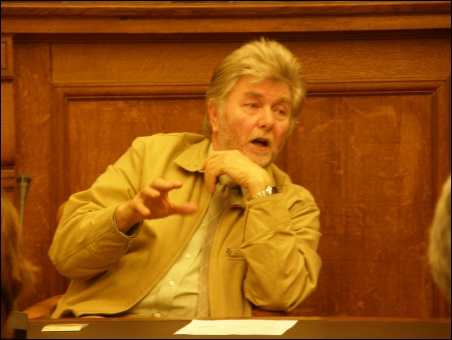 The meeting was organised by Burnham Chamber of Trade and saw Mr Woodham (pictured) outline his plans for an ‘energy causeway’ across the Bristol Channel that may run from Brean Down to Lavernock Point in Wales.
But Patrick Stokes claimed the amount of power generated by the barrage “could be hugely increased by building the whole structure further along the coast, from Minehead to West Aberthaw.”
“The cost of the scheme is estimated at £17 billion and it would be 4km longer if built at Minehead,” he said, “but it would generate considerably more power because of the extra water that would pass through it at that point. The route from Brean to Wales is wrong.”
 But Mr Woodham said his scheme would generate far more electricity than a typical power station.
“A power station generates 1,500 Mega Watts while the causeway would generate between 8,500 Mega Watts and 18,000 Mega Watts. It’s a huge difference.”
Responding to a question from the audience about how the barrage might affect flooding in the Burnham area following storms, Mr Woodham said the Severn Lake might actually help the situation: “We are looking at whether we could drain the lake on the northern side of the causeway, leaving just enough water for fish and wildlife, and let it act as a drain for river flood water.”
However, the idea of a lake being created behind the barrage was not welcomed by The Burnham And Somerset Levels Sea Flood Study Group.
Mr Stokes said: “We believe it would be fatal to have a lake. The Bristol Channel has been in its current state for hundreds of years. To create a lake would cause sedimentation. If you stop the flow of the tides, it won’t work.”
 But Mr Woodham stressed that there are no plans to halt the tides.
“We intend to have 198 turbines, each 7.9m in length along the causeway which will need the tide to come in and out to generate power.”
He added: “The idea that we are creating a stagnant lake just won’t occur.”
And Alex Turco, Chairman of the Burnham-On-Sea Chamber of Trade, added his weight to a barrage being sited in Minehead. “From a business point of view, it might well give us reduced insurance premiums and a reduced flood risk,” he said.
Members of the audience asked whether more research is being conducted on the effects the barrage might have on the Somerset coastline – to which Mr Stokes said a government sustainability and feasibility study is underway.
There were also questions about likely changes to tidal flows in Burnham. Coastal scientist Dr John White said it “is difficult to predict what changes there might be” despite a lot of research on the matter.
Mr Woodham also confirmed that a roadway is no longer being considered on top of the barrage. “A roadway is completely out of consideration,” he said. “A causeway with a road would bring so much more unwanted traffic to both sides. It’s not part of my scheme.”
He also addressed concerns that Brean’s tourist trade could be hit during the building of the barrage: “Brean Down is a very special place – we don’t want our causeway to affect it and with this in mind all building work will be carried out from specially-created docks out in the sea.”
It was also confirmed during Thursday’s meeting that the barrage would feature three viewing chambers for visitors to watch wildlife under the water, four marinas, and 12 islands. Mr Woodham also said that he had not discounted allowing homes to be built on the causeway – or even for wind turbines to be introduced to produce additional power.
He added that the development of the barrage could create up to 30,000 jobs and that he expects final planning consent for the construction another 5-7 years away.
But Mr Woodham said his project “must be running by 2020.” He concluded: “We are doing everything possible to make it a reality.”
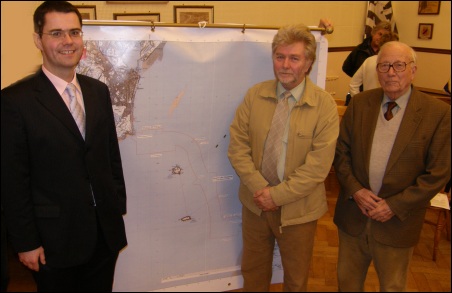
Alex Turco, Chairman of Burnham Chamber of Trade, inspected a plan showing where the proposed Severn Lake causeway may cross the Bristol Channel alongside Gareth Woodham and Patrick Stokes