

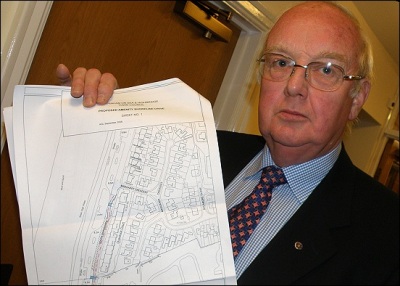
Plans to introduce a £29,000 traffic calming scheme to combat ‘boy racers’ and anti-social driving along Burnham-On-Sea’s Esplanade were unveiled for the first time on Monday (September 22nd).
Engineer Alan Lovell, pictured, was asked by the town council to draw up a scheme to convert the South Esplanade into a ‘shoreline leisure drive’.
Under the proposals, which were presented to councillors on Monday evening, a ‘stopping up order’ would be introduced to change the Esplanade from a public highway into a private drive.
A turning point would be introduced south of Margaret Crescent, and three ‘speed bumps’ would be added to the roadway near Margaret Crescent, Quantock Court and Burnham Holiday Village. Along with new road markings, there would also be narrower driving lanes to further slow traffic.
“Physical constraints on the public highway are the most likely way to curtail the anti-social driving problems experienced by residents and visitors,” said Mr Lovell, who carried out the work for the town council without charge.
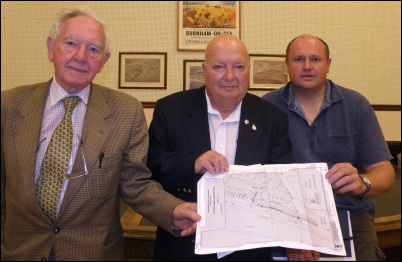 The council has set up a small sub-committee, comprising of Cllr Neville Jones, Cllr Eric Gill and Burnham police officer PC Pete Wills (pictured right), to discuss the plans in more depth.
PC Wills told Monday’s meeting: “There is a big problem along the South Esplanade that can be quite horrendous for some residents, whose windows shake every time speeding cars speed past.”
It comes just days after Burnham-On-Sea.com reported how Cllr Neville Jones had gained the majority support of members of Sedgemoor District Council for a new ‘leisure drive’ to be created along the Esplanade to try and combat the problems of anti-social driving.
Burnham-On-Sea.com reported last month that Somerset County Council’s Head of Highways, Ioan Rees, had stated “traffic calming of the South Esplanade would have a very low priority for funding from Highways budgets” and added that that the low number of accidents along the seafront means there is no argument for changes.
Seafront residents claim, however, that the situation is so bad that an accident is waiting to happen. Ian Halsley described the problem of noisy motorists as “a living hell”.