
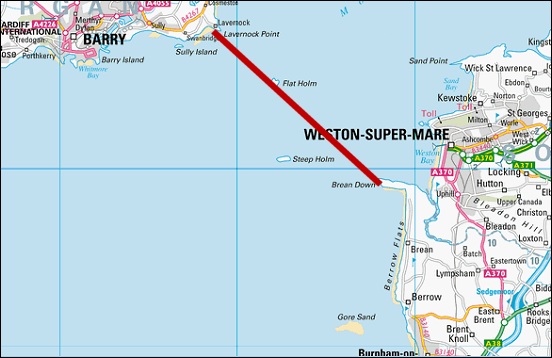
A mammoth £650 million project to build a barrage between Brean Down and Lavernock Point in Wales has been submitted to district planners this week.
Burnham-On-Sea.com interviewed Gareth Woodham, the wealthy entrepreneur and businessman from Neath who is behind the project, as he spoke for the first time about the plans for a 1km-wide barrage spanning the Bristol Channel, as marked on the map above.
 The ambitious proposal was submitted to Sedgemoor District Council on Wednesday and even includes 12 ‘islands’ with plush executive housing.
A council spokesman confirmed on Friday that it had received the huge proposal.
Mr Woodham, 58, believes the ambitious project will take up to 20 years to complete.
Motorists will be able to drive across the top of the barrage along a dual carriageway and there are even plans for a light railway.
The project will include 14 electricity generating turbines, four marinas and two lock gates to give ships passage.
Mr Woodham told Burnham-On-Sea.com: “Funding for the scheme will come from various sources. An energy company could fund the turbines and a building company the road.”
“I’ve set up a company called Combined Innovations Ltd to be the vehicle for the development.”
 “Only when the proposal hits John Prescott’s office in a few years will we know whether it will be tackled as a private initiative or a public one.”
“Indeed, the biggest problem I see is the planning problem. It could take longer to get the plans through than to build the project.”
He added that the scheme would create a huge lake in the estuary north of the barrage that would ideally be suited to pleasure sailing.
“I intend to call it the Severn Lake, a name that I have already trademarked. It would give it a better marketing angle.”
He added: “I plan to be sailing on it by the time I’m 80 years.”
“This is the first time a full application for a barrage has been put forward, even though it’s been talked about many times in the past.”
“Sedgemoor District Council are taking this seriously. They are looking for me to make a presentation over the next few weeks.”
 He says that further details about the scheme will be released later this month.
“I’m just amazed that no-one has put forward a proper application like this before.”
“Since an energy review is currently under way by the government, there’s no better time to do it. This scheme will generate electricity through water power.”
While many other barrage schemes have been proposed and failed, Mr Woodham says he is determined that his plan will be successful. “I will do this. Believe me, it’s going to happen this time.”
“People have been talking about a barrage for years – let’s stop talking and start building.”
.REACTION FROM BURNHAM-ON-SEA TOWN COUNCIL:
 Burnham and Highbridge Town Council Leader Peter Clayton gave Burnham-On-Sea.com his reaction to news of the barrage:
“We have to assume at this stage this is a genuine application, I feel it will have a very serious impact on the area, not Just Burnham but all of the Bristol channel. I am sure it will take many years of research to asses the impact of such a scheme. I am not an expert in this field, but I have some immediate concerns at this stage. The effect on beaches on both sides of the barrage and the flood risk as a result of altering what mother nature intended.”
“I feel there is scope for tidal energy generation in the channel, but I feel this might be a bit drastic for the area. I am sure our neighbours north of us will be very much against the scheme with the possible destruction of several seaside towns. It will be interesting to see the proposals and view any research on the impact.”
.PREVIOUS BARRAGE PROPOSALS:
 Interest in deriving large scale electrical power from the Severn Estuary began seriously in 1925 when an official study group was commissioned. A scheme of 800MW was investigated and although considered technically possible, it was prevented on economic grounds.
In 1975 the authority charged with meeting and delivering electrical supply in the UK, the Central Electricity Generating Board (CEGB), published a study with evidence from Bristol and Salford universities to the Secretary of State’s Advisory Council on Research and Development for Fuel and Power. From the study, the council established that a barrage could not be commissioned unless the energy situation deteriorated significantly in order for such a project to become economically feasible.
Building on the 1975 report, work continued from 1979 and 1986 at various levels which were initiated by the Department of Energy. Published in 1989, the scheme included a closed barrage 15.9km long with a total installed capacity of 8,640MW from 216 turbines.
RELATED LINKS:
Severn Lake [External Link]